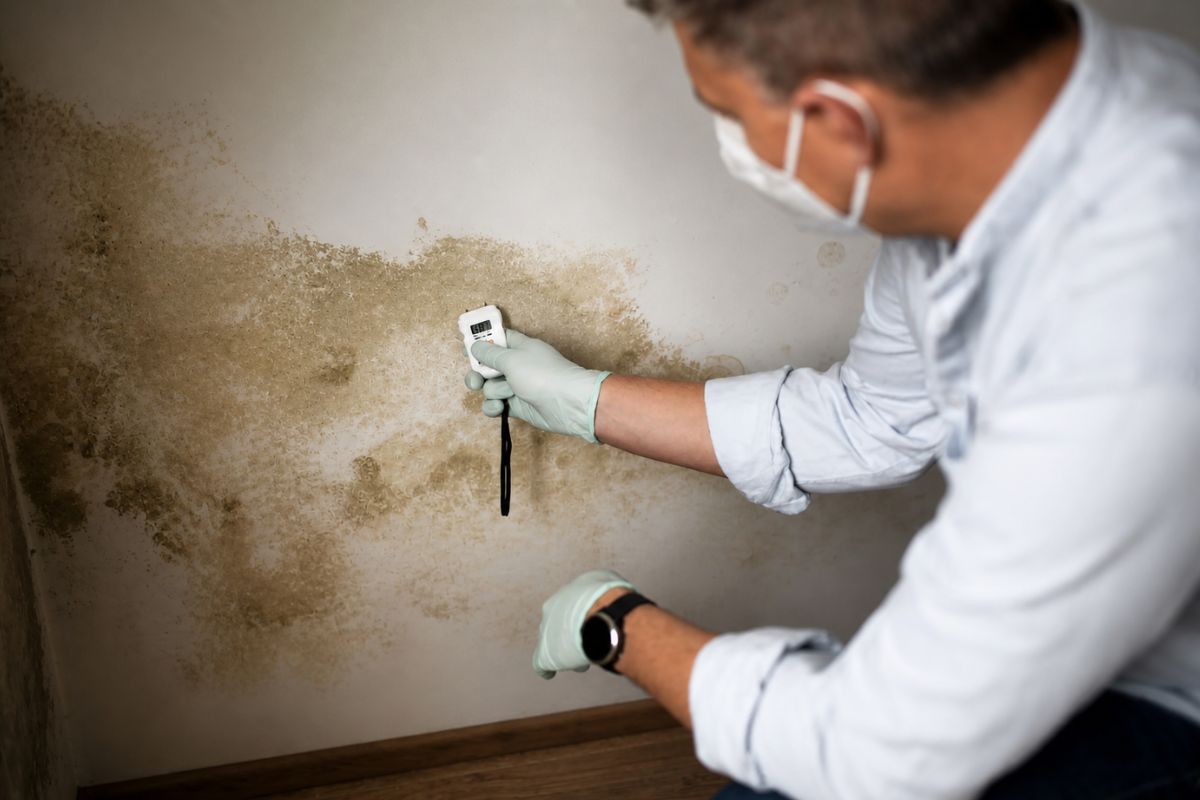
Water in NYC buildings is rarely confined to where you first see it.
Walls, ceilings, shared stacks, and structural cavities make sure of that. By the time a stain shows up, water has usually been somewhere it shouldn't be for hours.
A water damage assessment in NYC is how you figure out where it went and what it will take to fix it.
We’ll cover when to call for one, what's involved, what it costs, and what happens next.
Key Notes
A standalone water damage assessment in NYC runs $200–$1,500+ depending on scope and complexity.
Cat 1 clean water can degrade to Cat 2 or 3 within 48–72 hours if left sitting.
A professional assessment report is the strongest single piece of evidence in an insurance claim.
When You Need A Water Damage Assessment In NYC
You need a water damage assessment in NYC any time water has had a chance to move through building materials rather than sit on a tile floor. Or when more than one party (landlord, board, neighbor, insurer) is going to argue about cause and cost.
The Simple Rule Of Thumb:
If water touched drywall, insulation, wood, or another unit, treat the assessment as mandatory.
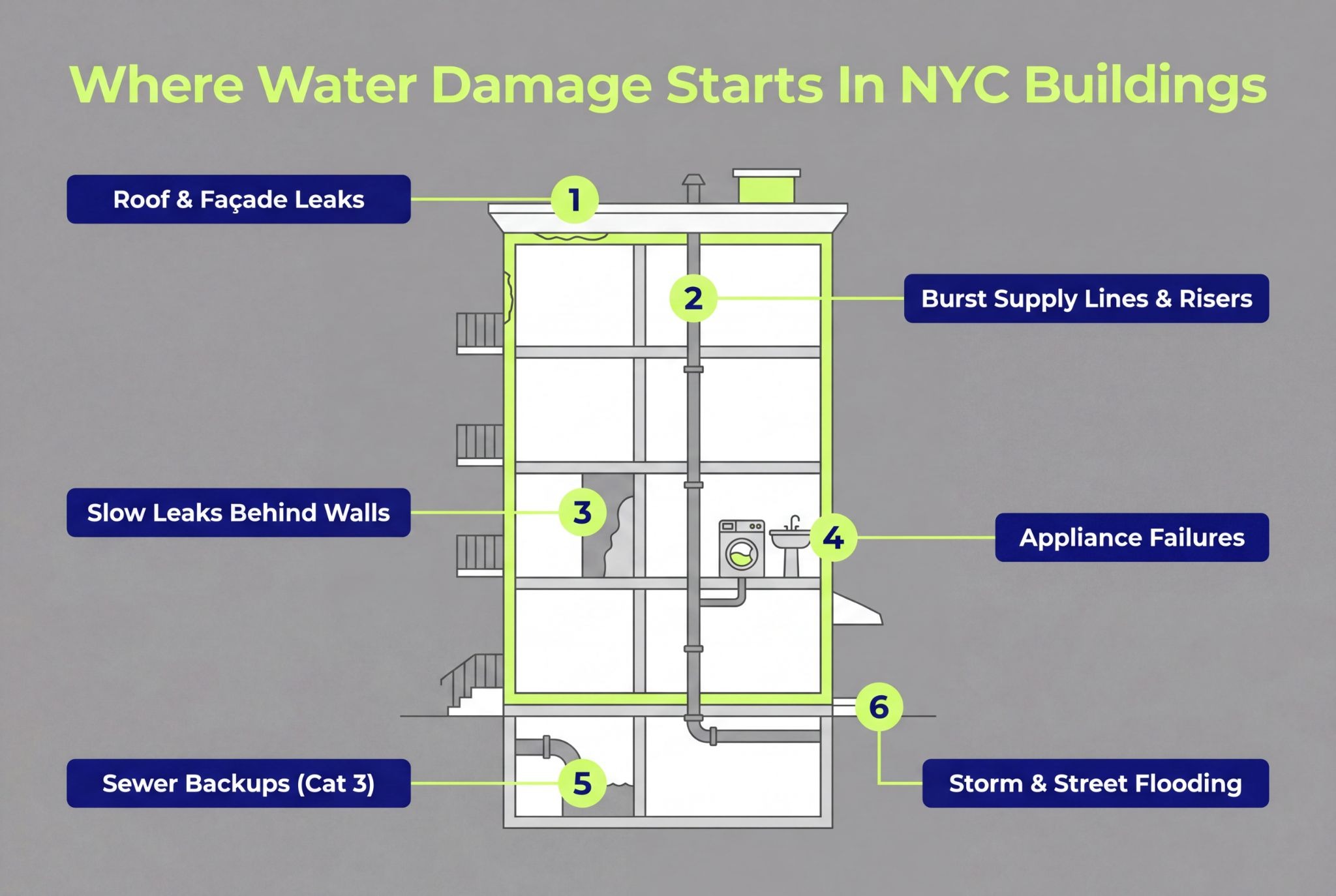
How Fast You Need Someone On-Site Depends On What Happened:
Scenario | Target Response Time |
Burst pipe / active leak | Same day, within hours if possible |
Flooding or sewage event | Within 24 hours of safe entry |
Late-discovered or chronic leak | Within a few days |
The 24–48 hour window matters for three reasons:
mold growth begins on wet porous materials in that timeframe
water keeps migrating into cavities and adjacent units
most insurance policies have a "duty to mitigate" clause that can reduce your payout if you wait too long
What's Involved In A Water Damage Assessment?
A water damage assessment in NYC combines on-site investigation, instrument readings, and documentation that can hold up under scrutiny from an adjuster or a co-op attorney.
For a single residential unit, the on-site portion usually takes about an hour.
Multi-room or multi-unit incidents run two hours or more, plus follow-up time to compile the report.
What The On-Site Work Covers
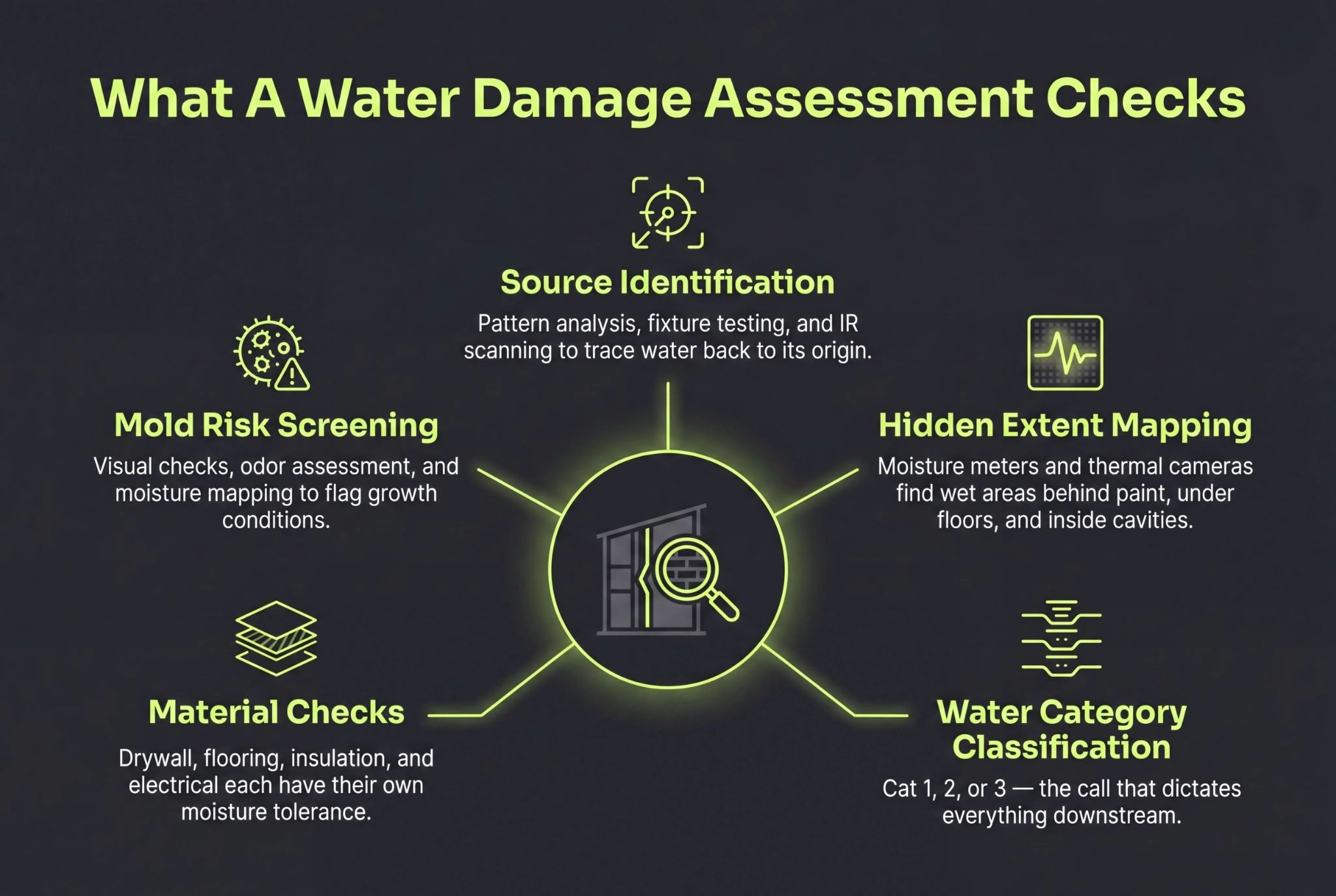
One Thing Worth Knowing:
The wet area you can see is almost always smaller than the area that needs drying. That gap is the whole reason instrument-based mapping exists.
What's In The Written Report?
Photo record (overview and close-ups, taken before any demo)
Sketches or floor plans with affected areas marked
Moisture readings logged against dry control areas
A source and cause narrative
Scope notes for drying, demolition, and rebuild
A summary suitable for an insurer, board, or property manager
Standards That Should Be Referenced
NYC restoration firms work to:
IICRC S500 (water damage)
S520 (mold) standards
Plus NYC Department of Health mold guidance
These aren't NYC-specific licenses, but they're the standards insurers and boards expect to see referenced in the report.
Water Damage Categories: Clean, Gray, and Black
Water category drives almost everything that happens next – protocol, cost, what gets saved, what gets ripped out:
Category | Source Examples | Typical Action |
Cat 1: Clean | Supply line burst, sink overflow, rainwater | Often dried in place; fastest, cheapest |
Cat 2: Gray | Washing machine, dishwasher, toilet bowl (no solids) | Selective demo, more containment |
Cat 3: Black | Sewage backup, street flooding, long-stagnant water | Porous materials removed; PPE and containment required |
One Thing Worth Knowing:
Cat 1 water can degrade to Cat 2 or Cat 3 within 48–72 hours if it sits in a warm cavity with organic material. That's a big part of why fast water damage remediation in NYC matters financially, not just for safety.
A clean burst caught on day one is a different job from the same burst found a week later.
Water Damage Assessment NYC Cost: What To Expect
A standalone water damage assessment in NYC cost typically runs $200–$600 for a single residential unit, and $600–$1,500+ for multi-unit, complex, or commercial work that requires formal reporting.
Scenario | Typical Assessment Fee |
Single apartment, contained incident | $200–$500 |
Multi-room or complex residential | $500–$800 |
Multi-unit / commercial / report-heavy | $800–$1,500+ |
Bundled into mitigation project | Usually $0 separate (rolled into per-sq-ft pricing) |
There Are 3 Pricing Models You'll See Across NYC:
Flat fee is the most common for single-unit residential work with a clear scope – predictable, includes basic testing and a short write-up.
Hourly or time-and-materials shows up for complex multi-unit jobs where the time required is genuinely uncertain, with rates that work out to roughly 1–3 hours of professional time on a typical visit.
Bundled into project scope is what you'll see on most emergency mitigation work – the assessment time is folded into per-sq-ft mitigation pricing (roughly $4–$5.50 per sq ft for clean water, $5–$7 for gray, $7–$8.50+ for black).
What Happens After The Water Damage Assessment
Drying starts fast – often during the same visit as the assessment – and the formal written report follows within 24–72 hours.
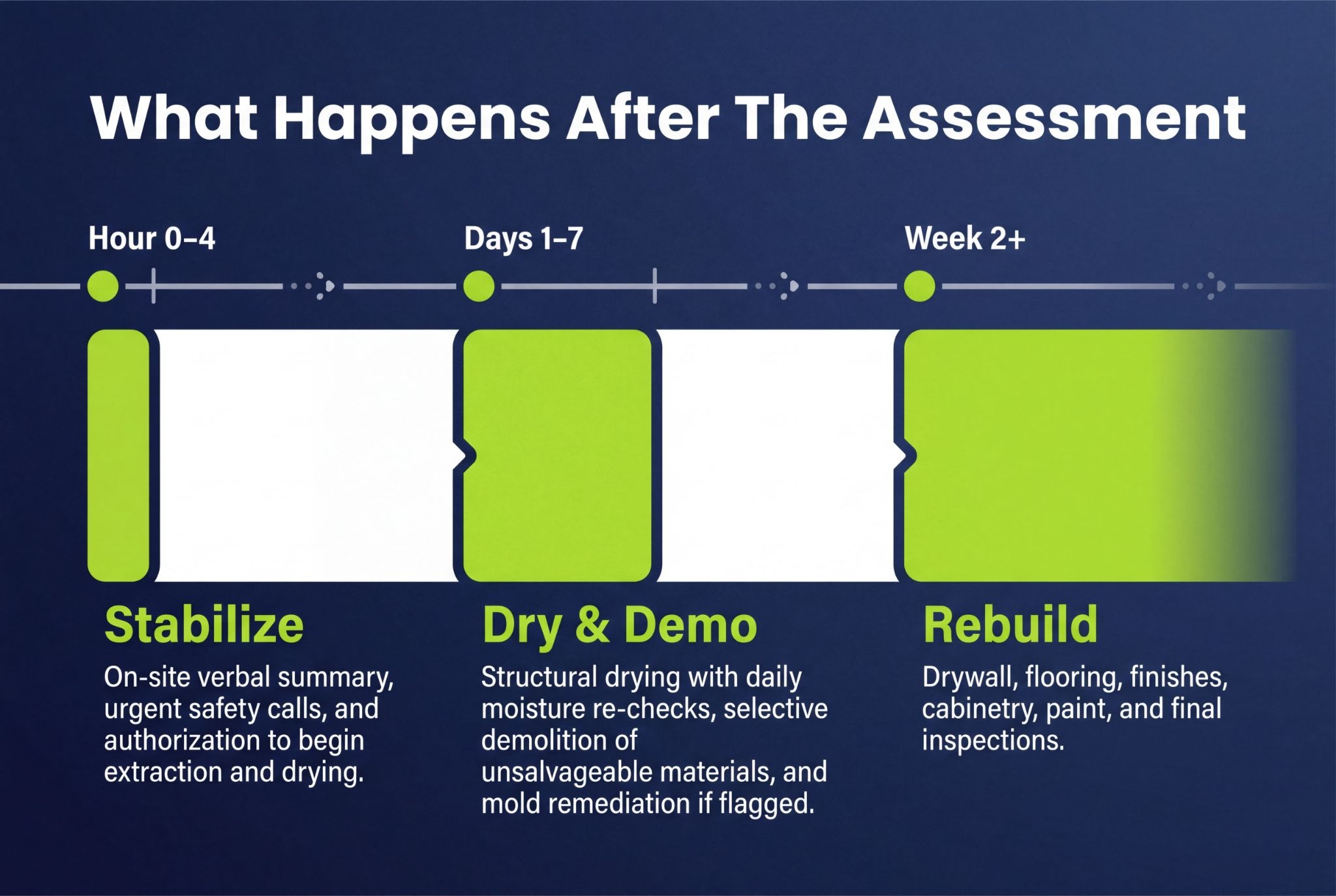
For minor incidents, the whole sequence wraps in two to three weeks. For moderate to severe damage, plan on several weeks to a few months for the full water damage restoration in New York process.
Drying is measured in days. Board approvals, neighbor access for shared walls, after-hours noise rules, DOB permits for structural or electrical scope, and contractor scheduling are measured in weeks.
The technical drying window is usually the easy part.
How A Water Damage Assessment Supports An Insurance Claim
A professional assessment is the strongest single piece of evidence you can hand an insurer. It links a specific event to specific damage, proves you acted promptly, and gives the adjuster industry-standard documentation they recognize.
The Documentation That Matters Most:
Time-stamped photos and video taken before any demo or drying equipment goes in.
Written professional report identifying source, category, and extent with moisture readings.
Itemized line-item estimate broken down by drying, demo, cleaning, and rebuild.
Inventory of damaged contents with values where possible.
A communication log with the insurer (claim number, emails, call notes).
The Sequence We Recommend:
Stop the leak, make the area safe, start documenting with your phone, notify the insurer within 24 hours, and get a contractor on-site for the formal assessment around the same time.
Don't rebuild before the adjuster has either inspected or received your documentation.
Common Mistakes That Turn A $3k Job Into A $20k One
The most expensive water damage in NYC usually isn't the dramatic burst pipe, but the leak someone painted over six months ago.
The Mistakes We See Most Often:
Treating only what's visible. Water moves sideways through joists, down through subfloors, and up through wicking. The stain on the ceiling is the smallest part of the problem.
Using shop vacs and household fans on Cat 2/3 water. Spreads contamination, aerosolizes pathogens, drives moisture deeper into materials.
DIY demo without moisture mapping. Cuts holes in dry areas, misses wet cavities, complicates the professional work that follows.
Bleach-and-paint mold "fixes." Cosmetic only. The moisture source and the growth inside the wall keep going.
Ignoring slow or intermittent leaks. Repeated wet-dry cycles cause more cumulative damage than a single dramatic event.
Doing repairs before the adjuster sees the damage. Creates disputes about scope and cost that can reduce or deny payout.
A clean Cat 1 burst caught and assessed within 24 hours typically lands at $3,000–$6,000 all-in for a single NYC apartment. The same incident ignored for six months – wet insulation rotting in the cavity, mold growth across framing, an expanded demo footprint, plus the mold remediation itself at $15–$30 per sq ft – easily reaches $10,000–$20,000+.
The assessment is what determines which side of that gap you end up on.
Water Damage Assessment NYC FAQs
Can I do a water damage assessment myself, or do I need a professional?
You can do a basic visual check yourself, but a proper water damage assessment requires moisture meters and thermal imaging to find hidden water behind walls and under floors. DIY checks miss 60–80% of actual damage, which is why insurers and co-op boards expect a professional report.
Does homeowners or building insurance cover water damage assessment costs in NYC?
Most policies cover water damage assessment costs when they're part of a covered claim – usually folded into the overall mitigation invoice. Standalone assessments for disputes, second opinions, or pre-existing conditions are typically out of pocket. Check your policy's "loss mitigation" or "reasonable expenses" language.
How quickly does a water mitigation contractor in NYC respond to emergencies?
A reputable water mitigation contractor in NYC should be on-site within 2–4 hours for active leaks and same-day for flood events. Anything beyond 24 hours risks mold growth, expanded structural damage, and reduced insurance payout under your policy's duty-to-mitigate clause.
What's the difference between water damage restoration and water damage remediation?
Water damage remediation is the cleanup phase – extraction, drying, decontamination, and mold control. Water damage restoration is the rebuild – drywall, flooring, finishes, and repairs to bring the property back to pre-loss condition. Most NYC jobs need both, often from the same contractor.
Need Answers Before The Damage Spreads?
24/7 NYC dispatch, insurance-ready reports, no callback delays.
Conclusion
The financial gap between a well-handled water event and a poorly handled one in NYC is usually five figures wide, and the assessment is the deciding factor.
A proper water damage assessment in NYC catches the moisture you can't see, classifies the contamination correctly, gives your insurer the documentation they need, and sets the scope before walls open up and surprise you.
Skip it or rush it, and you're paying for mold remediation, expanded demo, and disputed claims six months later. The first 24 hours decide most of it.
If water is moving through a building right now or you're staring at a stain that wasn't there yesterday, a licensed assessor on-site quickly is the cheapest decision you'll make this year. Book your appointment now.